

Imagine a colleague trying to confirm whether a customer still qualifies for an exception. The policy is in a shared folder. The original approval is in an old conversation. The person who remembers the reasoning has changed roles.
Finding the policy is easy. Working out whether the exception still applies takes three conversations.
A founder or operations leader may recognize the pattern: work keeps returning to the people who remember how things happened. As more colleagues need that context, those people become a dependency for decisions they no longer directly manage.
This is the question behind FoliPlace’s research: as companies grow, their collective knowledge doesn’t always scale with them. A team can gain expertise while making that expertise harder for others to use.
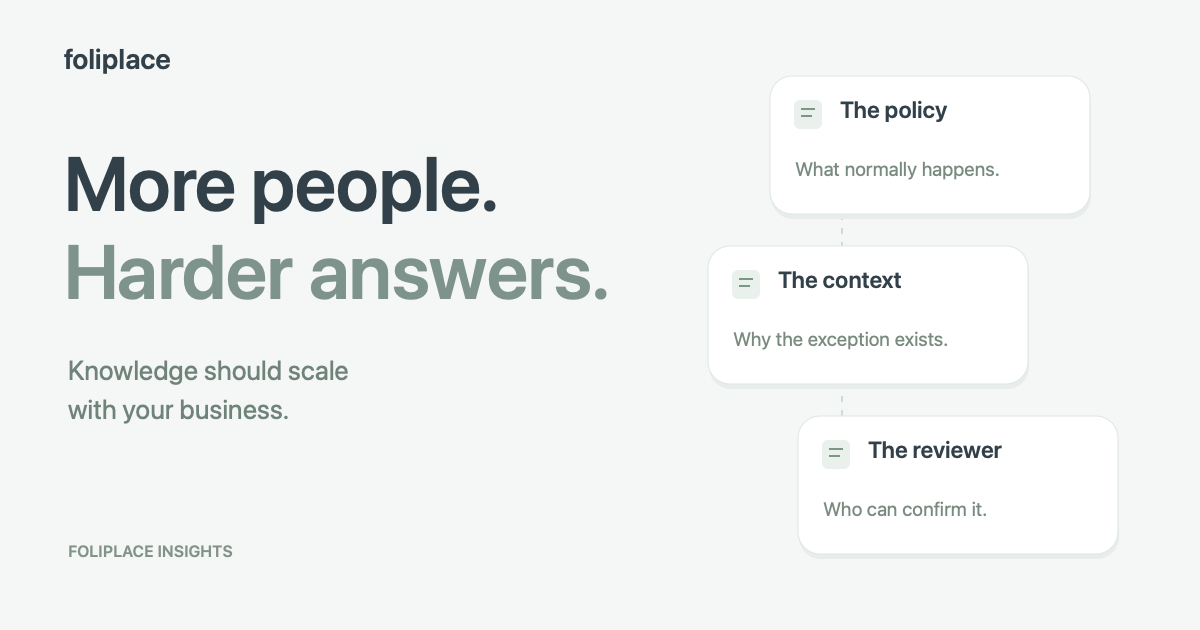
Follow the question
The policy is
only one piece.
Explore the difference between finding a document and finding enough context to act.
Each piece contributes something different to the decision.
Illustrative scenario. This compares ways to organize context; it is not a FoliPlace product demonstration.
The company knows more than the documents say
In a small team, a conversation can supply the context a document leaves out. People may remember why a customer received different terms, which workaround failed or who should approve an unusual request.
As responsibilities spread, a colleague can encounter a decision without having been part of the conversation that produced it. The final instruction survives. Its assumptions, exceptions and history may be harder to recover.
APQC’s guidance on knowledge transfer distinguishes explicit knowledge, which can be documented, from tacit knowledge developed through experience. It describes interviews, peer learning and documentation as approaches suited to different transfer needs.
For the customer exception, an archived approval might establish what happened last time. Someone still needs to determine whether the same conditions apply now. Search, context and decision authority each play a role.
My working interpretation is that growth can expose a dependence on shared memory. When the people doing the work no longer share the same history, the company needs a reliable way to connect them to relevant guidance and judgment.
Three signs that access to knowledge is breaking down
Start with a task that recently stalled. These three patterns can help identify where to look.
The same question keeps returning. An experienced employee answers it again because the earlier explanation is difficult to find or use. Before writing another document, check what prevented the previous answer from helping the next person.
The document exists, but ownership is unclear. A colleague finds relevant guidance and still has to ask around for someone who can confirm it. A department name is often too broad to resolve a specific exception.
Several answers look plausible. An old procedure, a recent message and a colleague’s recollection point in different directions. The task waits while someone determines which guidance applies.
Different causes call for different fixes. A confusing policy needs clarification. A permissions issue needs an access decision. A recurring exception may need a clearer approval process. Treat each incident as a way to locate the failure before choosing a tool.
Trace one question from request to resolution
Choose a recurring question that delays meaningful work. Ask the person who last encountered it to walk through what happened: where they looked, who they contacted and what finally allowed them to proceed.
APQC’s knowledge mapping guidance examines the knowledge a process requires, how it can be accessed and when it is needed. That provides a useful foundation for a focused exercise.
For the customer exception, I would test a short record with four elements.
A structure to try
One answer.
Enough context to use it.
What applies now.
State what the business has confirmed and the conditions under which it applies.
Part of the same answer record: guidanceKeep the reason.
Preserve why the exception exists and what would require a fresh decision.
Part of the same answer record: contextShow the basis.
Link to the policy or approval that supports the guidance, respecting existing access permissions.
Part of the same answer record: evidenceMake ownership visible.
Identify who can confirm the guidance, when it was last checked and what change should trigger another review.
Part of the same answer record: reviewerAn editorial exercise to test with your team.
APQC’s content ownership guidance assigns responsibility for accuracy and currency to a named business owner. The record needs someone who can keep it useful as circumstances change.
Try it with a colleague who was not involved in creating it. Observe whether they can find it, understand its limits and identify the next step. If they still need three conversations, find out what is missing.
This is a proposed starting exercise. It may reveal that a clearer onboarding step or a simpler process is sufficient. The result matters more than the number of records created.
Apply the same test to AI
APQC’s 2026 priorities summary connects AI readiness with knowledge quality, governance and ownership. Those foundations remain relevant when a team adds an AI search or answer tool.
For this use case, I would test whether the tool helps someone reach a supported answer and recognize when a person needs to make a decision. A useful response should make its evidence and limits clear. Where guidance conflicts or an approval is missing, the business still needs a way to resolve the uncertainty.